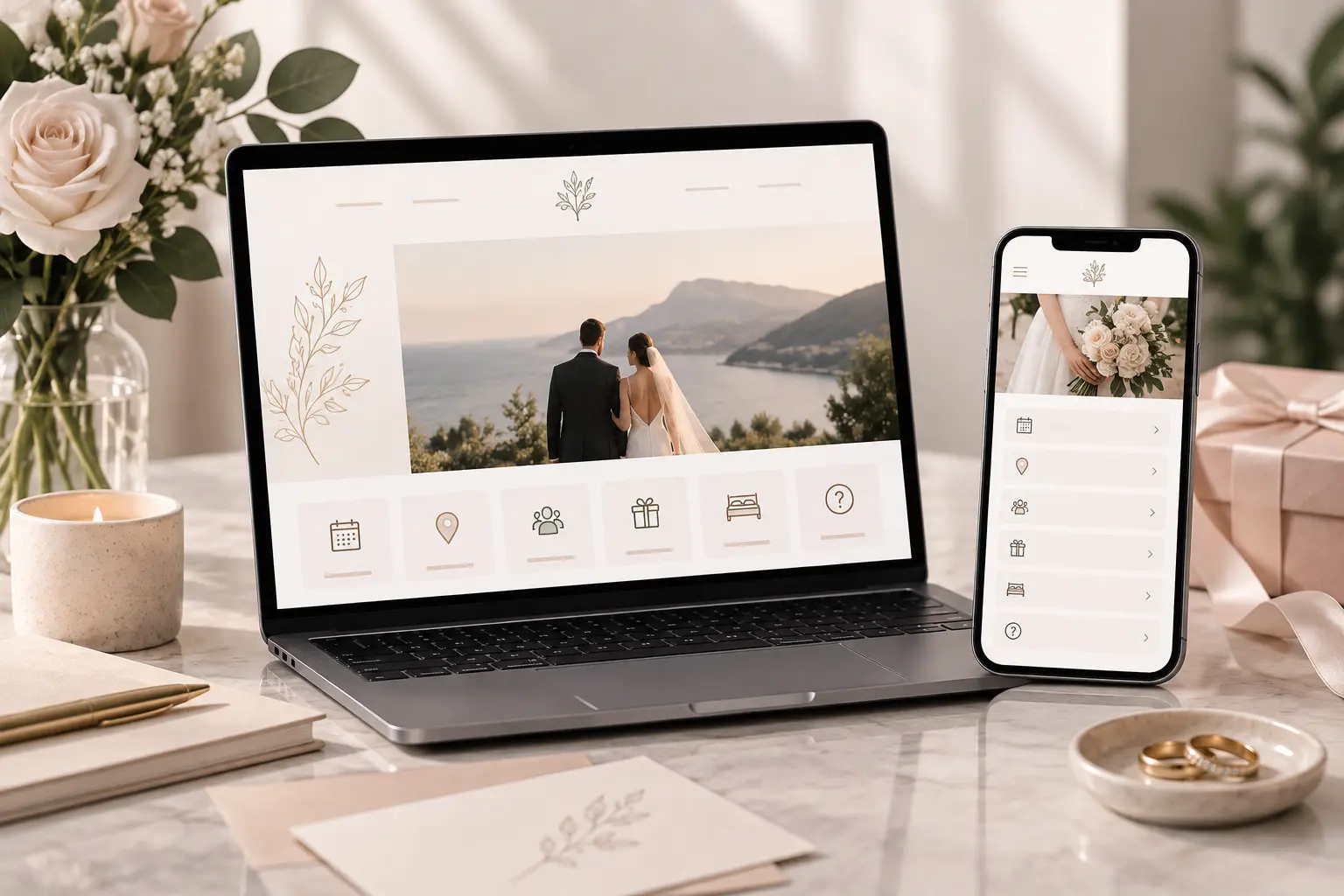
A wedding website serves as a central place for sharing important event information with guests. It can bring together the wedding date, venue details, schedule, RSVP (Répondez s'il vous plaît) instructions, registry links, accommodation information and answers to common questions. A simple structure makes these details easier to find before and during the celebration.
The process typically begins with selecting a suitable website design agency or website platform and template. The design can then reflect the wedding style through colors, typography, photographs and other personal details. Essential information needs to remain clear, especially venue addresses, event times, dress codes, parking and transportation arrangements.
An RSVP (Répondez s'il vous plaît) section can help collect attendance details and meal preferences, while a registry section can direct guests to preferred stores or gift options. An FAQ (Frequently Asked Questions) section can address practical questions about children, plus-ones, accommodation or transportation.
Before sharing the website, review the content, test the RSVP process and check the layout on mobile devices. Once published, the website can be shared through invitations, save-the-dates, or direct messages and updated whenever event plans change.
What is a wedding website?
A wedding website is a dedicated online hub where couples bring together the essential information guests need before and during the celebration. It can cover the wedding date, venue addresses, event schedule, dress code, travel and accommodation details, RSVP (Répondez s'il vous plaît, meaning “please respond”), registry links and answers to common guest questions. Unlike printed invitations, the information can be updated when plans change, such as venue details, schedules or weather arrangements.
The site can also reflect the couple’s personality through photos, a short love story, wedding-party details and a design that matches the celebration. Mobile-friendly layouts make essential information easier to access while guests are traveling or checking details at the venue. An FAQ (Frequently Asked Questions) section can address practical concerns about children, plus-ones, transportation, parking, dietary needs and accommodation.
Beyond logistics, a wedding website can become a digital record of the celebration. Shared through invitations, save-the-dates, or a direct link, it gives guests one reliable place to return to throughout the wedding planning process.
Why do you need a wedding website?
A wedding website gives couples one reliable place to organize essential wedding information and keep guests informed as plans develop. Instead of answering repeated questions about venues, dress codes, parking, accommodation or registry details, couples can direct guests to a single online resource that remains accessible before and during the celebration. Current wedding guides consistently highlight centralized information and easier guest communication as key benefits.
It can also simplify RSVP (Répondez s'il vous plaît, meaning “please respond”) management by collecting attendance confirmations and meal preferences in one place. For destination weddings or multi-day celebrations, travel information, hotel options, maps, transportation details and event schedules can give guests clearer guidance before they arrive. An FAQ (Frequently Asked Questions) section can further reduce repeated messages by addressing common concerns about children, plus-ones, dietary requirements and directions.
A wedding website also provides room for personal details such as the couple’s story, photos and information about cultural traditions. Unlike printed invitations, you can update its content when schedules, venues, or other arrangements change.
When do you need to create a wedding website?
The best time to create a wedding website is after you confirm the wedding date and venue, ideally several months before guests need travel or event details. Current wedding planning guides commonly place the initial launch around 6 to 12 months before the wedding, while destination weddings often benefit from an earlier launch because guests need more time to arrange flights, accommodation and time off.
The website does not need to be complete when it first goes live. An early version can contain the couple’s names, wedding date, location and basic event information. Travel details, accommodation options, registry information, RSVP (Répondez s'il vous plaît, meaning “please respond”) and other guest resources can be added as arrangements become more certain. This staged approach keeps the site useful without delaying its launch until every detail is finalized.
For destination weddings, launching around 9 to 12 months ahead can give traveling guests more planning time. For local celebrations, a shorter lead time can work when most guests live nearby. The website also needs regular updates as schedules, accommodation details, transportation, or venue information change.
How long does it take to build a wedding website?
A basic wedding website can often be created in under an hour when a template-based platform is used, while a more personalized site can take several hours depending on the amount of content and customization. Current wedding website platforms such as The Knot promote setup in minutes, with the main work involving selecting a design, adding wedding details, photos, registry information and RSVP features.
The timeline depends less on technical difficulty than on how much information needs to be prepared. A simple site with names, date, venue and RSVP (Répondez s'il vous plaît, meaning “please respond”) details can go live quickly. Adding a love story, photo galleries, travel information, accommodation, schedules, registry links and an FAQ (Frequently Asked Questions) section takes longer, particularly when content and images still need to be gathered.
A wedding website also does not need to be finished in one sitting. Couples can publish the core information first, then add details as plans become clearer. Regular updates are useful because wedding websites often remain part of the planning process through the event, rather than functioning as a one-time setup task.
What is the best wedding website platform to use?
The best wedding website platform depends on the features that matter most, such as registry integration, RSVP management, design flexibility, guest tools, or stationery matching. Current comparisons commonly place Zola, The Knot, Minted and Squarespace among the leading options, but each serves a different type of wedding planning need.
Zola works well for couples who want a connected wedding website, registry and guest-management experience. Its platform combines website templates with registry integration, guest lists, RSVP tracking, travel information and password protection.
The Knot suits couples who want a broader wedding-planning ecosystem alongside the website. Its tools connect the site with RSVPs, registries, guest lists and other planning resources.
Minted is a strong choice when visual design and matching wedding stationery are priorities. Its artist-designed websites can coordinate with invitations and other printed pieces.
Squarespace offers greater control over layout and visual presentation, making it more suitable for couples who want a highly customized site. It requires more hands-on setup and does not provide the same wedding-specific planning ecosystem as dedicated platforms.
The right platform is therefore the one that matches the wedding’s planning needs rather than simply having the most features.
How can a wedding website design be customized?
A wedding website can be customized through its template, colors, typography, imagery, page structure and wedding-specific content. Platforms such as Zola, The Knot and Squarespace provide design tools that let couples adjust layouts, upload photos, change colors and fonts and organize sections around the information guests need.
Start with a template that fits the wedding style, then adapt the visual details to create a consistent look across the website. Engagement photos, the couple’s story, wedding-party details and meaningful cultural or family traditions can add personality without making the site difficult to navigate. Sections can also be arranged around practical needs such as the schedule, travel, accommodation, registry, dress code and RSVP.
A custom domain can make the website easier to remember and share, while features such as password protection can provide additional privacy. Advanced customization may also support videos, galleries, maps or other embedded content depending on the platform.
Mobile presentation also needs attention because guests may check directions, schedules or RSVP details from phones. Responsive wedding templates help keep text, images and navigation usable across different screen sizes.
What information does a wedding website need to include?
A wedding website needs to include the practical details guests need to attend, respond and prepare for the celebration. Core information typically covers the wedding date, ceremony and reception locations, event schedule, dress code, RSVP (Répondez s'il vous plaît, meaning “please respond”), registry and travel or accommodation details. Current wedding guides also recommend clear directions, parking and transportation information so guests can plan their arrival without relying on separate messages.
For guests traveling from outside the area, the site can provide hotel recommendations, room-block information, nearby airports, transportation options and local activities. A registry section can link to preferred stores or gift funds, while RSVP details can collect attendance responses and meal preferences.
An FAQ (Frequently Asked Questions) section can address common concerns about children, plus-ones, attire, parking, dietary requirements, venue directions and schedule details. For multi-day celebrations, a clear itinerary can organize each event by date, time and location.
Personal content such as the couple’s story, engagement photos and wedding-party introductions can make the site feel more personal without distracting from its main purpose. A contact method and timely updates are also useful when arrangements change.
How does online RSVP work on a wedding website?
Online RSVP lets guests confirm attendance through a wedding website instead of returning a paper response card. A typical process connects the RSVP form with the guest list, allowing guests to find their invitation, indicate whether they will attend and provide additional details such as meal preferences or dietary requirements. Platforms such as Zola and The Knot can update guest responses in real time.
The process usually begins with a guest opening the RSVP page through the wedding website link. Depending on the platform, the guest may enter a name to find the invitation or access a personalized RSVP form. The form can cover multiple events, such as the ceremony, reception or welcome dinner, so each guest responds only to events included in the invitation.
Couples can add follow-up questions for meal choices, allergies, transportation needs, song requests or other guest details. Responses are then stored with the guest list, making attendance counts and meal information easier to review. Some platforms also provide privacy settings, notifications, reminders or data exports for planning purposes.
Before sharing the RSVP link, the form needs to be tested from a guest’s perspective. Checking names, invited events, questions and mobile usability can prevent confusion when responses begin arriving.
What is the best way to share a wedding website?
The best way to share a wedding website is through the save-the-date, invitation details and direct digital messages, with a QR code as a convenient option for printed stationery. Wedding planning sources consistently recommend sharing the site early and repeating the link at key points as more information becomes available.
A save-the-date can introduce the website when the date and location are confirmed, while an invitation or details card can direct guests to RSVP (please respond) instructions, accommodation, travel information and the event schedule. Email, text messages and private guest groups can provide additional access, particularly when updates need to reach guests quickly.
For printed materials, a QR code can open the website without requiring guests to type the URL. A short written URL can also be placed beside the code as an alternative. The QR code needs to be tested on multiple phones before printing and the linked page needs to work well on mobile devices.
A custom domain can make the address easier to remember, while regular website updates keep guests informed about schedule changes, accommodation, transportation and other final details.
How can a wedding website be made mobile-friendly?
A wedding website becomes mobile-friendly when its layout, navigation, text and interactive elements work comfortably on small touchscreens. Responsive wedding templates can adapt content across phones and tablets, but the finished site still needs testing on different screen sizes to catch layout or usability problems.
Keep the mobile layout simple. Use readable body text, generous spacing and clear navigation so guests can quickly find the date, venue, directions, registry and RSVP (please respond) details. Important actions such as RSVP and directions can remain easy to reach without excessive scrolling.
Images also need optimization because large files can slow page loading on mobile connections. Maps, phone numbers and RSVP forms need to work directly through touch interactions, with buttons large enough to tap comfortably. A short Frequently Asked Questions (FAQ) section can further reduce scrolling by grouping common guest concerns in one place.
Before publishing, test the website on both iOS and Android devices. Check menus, forms, maps, images, links and page orientation rather than relying only on a desktop preview. A mobile-friendly wedding website prioritizes fast access to essential guest information over decorative features that add unnecessary complexity.
What should be on a wedding website?
A wedding website needs to combine essential wedding details with useful guest information and a small amount of personal content. Current wedding planning guidance consistently recommends the wedding date, venue, event schedule, dress code, RSVP (please respond) details, registry, travel information and accommodation details.
The main sections of a wedding website are listed below.
Wedding details: Ceremony and reception locations, dates, times, dress code, parking and transportation information.
RSVP: A clear response option with the deadline, attendance confirmation, meal preferences and relevant dietary questions.
Travel and accommodation: Hotel blocks, nearby lodging, airport information, transportation options and directions, particularly for guests traveling from outside the area.
Registry: Links to gift registries, honeymoon funds or other preferred gift options.
Frequently Asked Questions (FAQ): Answers about children, plus-ones, attire, parking, dietary restrictions, gifts and other details that guests may ask before the event.
Personal details: A short love story, engagement photos, wedding-party information or local recommendations can give the site a more personal feel without distracting from essential logistics.
Contact information: A designated email address or contact person can handle questions that the website does not answer.
What time does the wedding ceremony start?
The wedding ceremony starts at the time listed on the invitation and wedding website. A clear website design can also show the recommended arrival time, giving guests enough time for parking, seating and finding the ceremony location before it begins.
What is the dress code?
The dress code explains what guests are expected to wear for the wedding. The wedding website can identify the formality level, such as black tie, formal or cocktail, with brief guidance about suitable attire, footwear or outdoor conditions.
Where should guests stay?
Guests should stay at the recommended accommodations listed on the wedding website, preferably near the venue. Useful details include hotel blocks, booking links, group codes, nearby alternatives and approximate distances so guests can select suitable lodging.
How can guests RSVP?
Guests can RSVP through the wedding website by opening the RSVP section and submitting an attendance response. The form can also collect meal preferences, dietary requirements and responses for additional events before the stated RSVP deadline.
How do guests get to the wedding venue?
Guests can get to the wedding venue using the directions and transportation information provided on the wedding website. This section can include a map link, parking details, shuttle schedules, public transportation options and rideshare guidance.
.svg)
.svg)
.svg)
.svg)