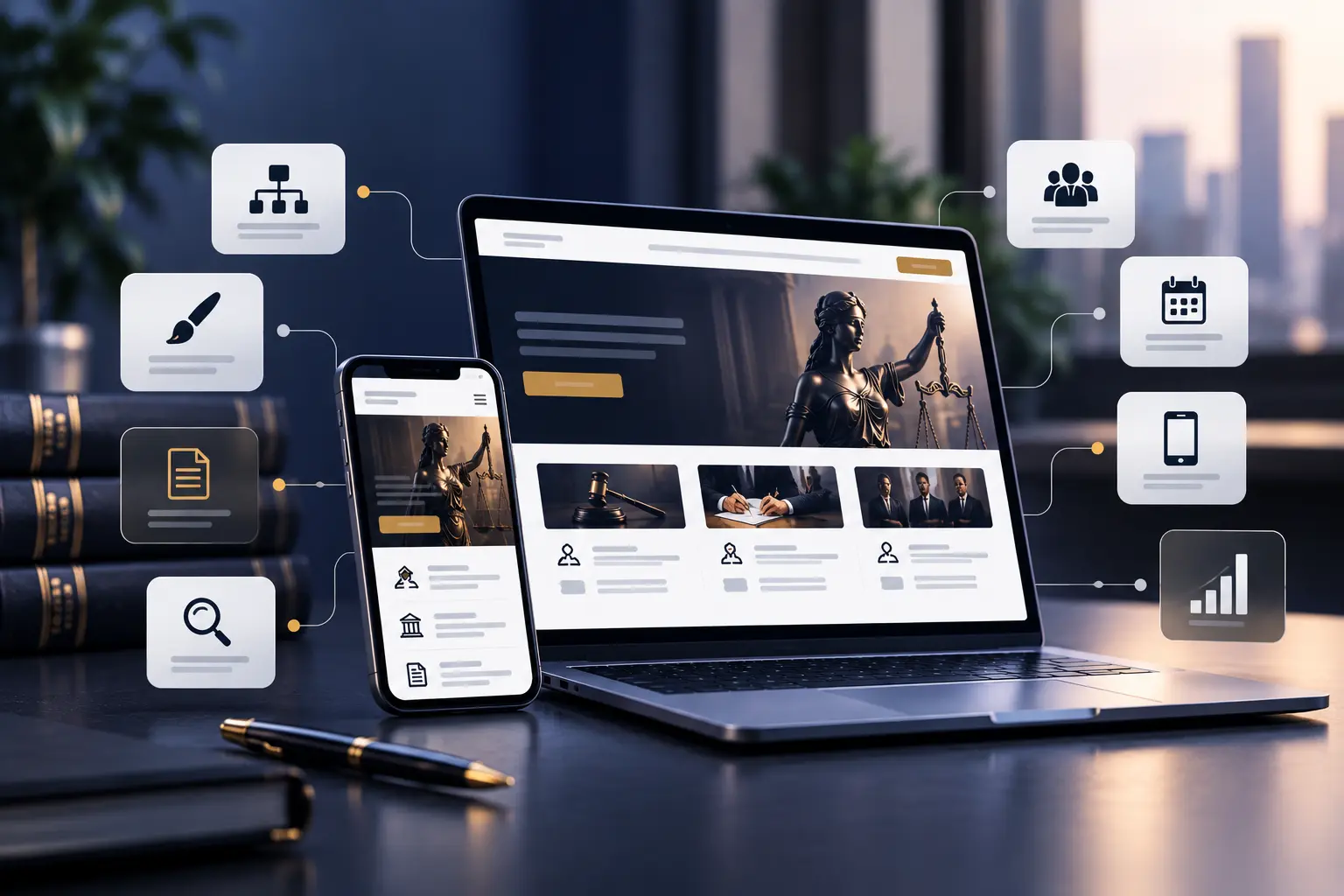
Law firm website design services typically include strategy, custom design, practice-area pages, attorney profiles, search engine optimization (SEO), intake forms and mobile optimization. These elements help prospective clients find relevant legal services and contact the firm.
Website strategy defines the site structure around practice areas, target clients and consultation paths. A clear sitemap helps visitors reach relevant legal information without unnecessary navigation.
Custom design establishes a visual system that reflects the firm's identity and professional positioning. Responsive layouts also help visitors access pages across phones, tablets and desktop devices.
Practice-area pages explain specific legal services with focused information and clear calls to action. Dedicated pages can also support local and practice-specific search visibility.
Attorney profile pages present credentials, bar admissions, experience and relevant professional information. These details help visitors assess which attorneys handle their legal needs.
Intake features create a direct path from website visit to consultation request. Forms, phone links, scheduling tools and CRM integrations can support that workflow.
Technical services can include accessibility, performance, security, analytics and technical SEO. Legal websites also need content and advertising practices that match applicable jurisdictional requirements.
A complete law firm website service therefore covers more than visual design. The scope can connect legal content, search visibility, credibility, accessibility and client intake within one website system.
What are law firm website design services?
Law firm website design services create a public website that explains legal services and supports client enquiries. The scope usually combines strategy, page structure, visual design, development, content and search optimization.
Website strategy defines the site's structure around practice areas, locations and client needs. A clear hierarchy helps visitors find relevant legal information with fewer steps.
Practice-area design gives each major legal service a focused page. These pages can explain services clearly and support practice-specific search intent.
Attorney profile design presents credentials, experience, jurisdictions and professional information. These profiles give prospective clients useful context before they contact the firm.
Client-intake design creates clear paths for calls, enquiries and consultation requests. Forms need careful scope because prospective clients may submit sensitive case information.
Search optimization structures titles, metadata, internal links and local information around relevant legal searches. Technical work can also address performance, mobile usability and structured data.
Accessibility design improves keyboard navigation, semantic structure and content access. Compliance requirements can vary by jurisdiction, so the project needs appropriate legal and technical review.
Legal website services can also include content governance, analytics, security and post-launch maintenance. The exact scope depends on the firm's practice areas, locations and required functionality.
Law firm website design therefore extends beyond visual presentation. A complete service connects legal information, attorney credibility, search visibility, accessibility and client intake within one website structure.
What’s the typical cost of a law firm website design project?
A professional law firm website design project typically costs $3,000 to $25,000+ in 2026. Smaller firms often fall near $3,000 to $10,000, while larger custom projects can exceed $25,000.
The main law firm website cost ranges are shared below.
Project scope drives the largest cost differences. Practice areas, attorney profiles, content depth, intake tools and custom features can expand development work.
Custom design also raises the project fee. Published 2026 pricing shows custom legal websites can start around $5,000 and increase with page volume and functionality.
Client intake features can add another cost layer. Appointment booking, confidential enquiry forms, portals and external integrations require additional technical work.
Ongoing services create separate expenses after launch. Hosting, maintenance, security and SEO can add recurring monthly costs beyond the initial website build.
The quoted price therefore needs comparison against scope rather than the headline number. A useful proposal identifies pages, functionality, content, revisions, ownership, integrations and post-launch support.
Why does SEO matter so much for law firm websites?
SEO (Search Engine Optimization) helps law firm websites appear for relevant legal searches before a potential client contacts a firm. Search visibility matters because many legal searches carry clear practice-area or local intent.
Practice-area SEO connects specific legal services with specific search needs. Dedicated pages can target searches for family law, personal injury, criminal defence or business law.
Local SEO connects those services with geographic intent. Google uses relevance, distance and prominence when it determines local results, including Google Business Profile (GBP) visibility.
Legal content also needs stronger trust signals because law falls within YMYL (Your Money or Your Life) topics. Accurate information, attorney credentials and clear authorship can strengthen credibility.
Technical SEO helps Google discover, understand and index important pages. Clear site structure, internal links, mobile usability and descriptive page elements support that process.
SEO also gives law firms a channel beyond paid advertising. Useful pages can continue attracting relevant organic visits after publication, although results require time and consistent work.
Law firm SEO therefore connects search visibility with practice areas, locations, credibility and client enquiries. A strong website needs these elements to work together rather than treating SEO as a separate marketing layer.
What features make an effective law firm website today?
An effective law firm website combines clear messaging, practice-area depth, attorney credibility, mobile usability, accessibility and simple client intake. These features help visitors understand the firm and decide whether to make contact.
The main features of an effective law firm website are listed below.
Clear homepage messaging: The homepage explains the firm’s services, locations and client focus without unnecessary detail.
Dedicated practice-area pages: These pages address specific legal problems and explain relevant services in client-focused language.
Detailed attorney profiles: These profiles present credentials, bar admissions, experience, publications and relevant professional background.
Trust signals: Reviews, testimonials, case information, awards and media mentions can support credibility, subject to applicable ethics rules.
Mobile-first performance: Mobile layouts keep navigation, text, buttons and forms usable across smaller screens.
Accessible navigation: Accessible interfaces support keyboard users, screen readers, readable contrast and other accessibility needs.
Visible contact options: Phone numbers, email links, enquiry forms and scheduling tools provide clear contact paths.
Privacy notices and legal disclaimers: These notices explain information use and clarify when website communication does not create an attorney-client relationship.
Search-friendly structure: Descriptive headings, crawlable links and useful content help search engines understand important website pages.
How do we know if a web design company understands the legal industry?
A web design company understands the legal industry when it can address legal ethics, practice-area structure, client confidentiality, accessibility and search visibility. A polished portfolio alone does not demonstrate that level of industry knowledge.
The main signs of legal industry expertise are listed below.
Legal portfolio experience: Recent law firm projects show whether the agency understands legal website requirements and professional-service expectations. Past client references can provide additional evidence of project experience.
Ethics awareness: Knowledge of lawyer advertising rules helps the agency identify potential issues with claims, testimonials, case results and specialization statements.
Practice-area strategy: A clear page structure connects legal services with the problems prospective clients search for. Relevant pages also explain services and appropriate next steps.
Confidential intake knowledge: Contact forms, chat tools and consultation systems can receive sensitive information. The agency needs clear privacy and information security procedures for these features.
Legal SEO knowledge: SEO strategy needs to connect practice areas, locations and useful content with relevant search intent. Redesign plans also need to protect existing search visibility.
Accessibility expertise: Accessibility knowledge helps the agency support keyboard navigation, readable content, screen readers and other assistive technologies.
Client-experience testing: Testing mobile navigation, forms, scheduling tools and contact paths shows whether the website works from a prospective client’s perspective.
How can we evaluate if a law firm website agency delivers results?
A law firm website agency delivers measurable results when website data connects search visibility with qualified enquiries and new clients. Traffic alone cannot show whether the website supports business goals. The American Bar Association (ABA) recommends regular marketing metrics and web analytics reviews for this reason.
The main measures for evaluating a law firm website agency are listed below.
Organic search traffic: Relevant legal searches bring visitors to the website. Google Search Console reports queries, impressions, clicks and search positions.
Conversion rate: Visitors take actions such as calls, form submissions or consultation requests. Page-level tracking identifies which practice pages generate those actions.
Lead quality: Enquiries match the firm’s practice areas, location and case criteria. A higher enquiry volume does not always indicate stronger website performance.
Lead-to-client rate: Qualified enquiries become paying clients. This measure helps distinguish website performance from weaknesses in the intake process.
Cost per lead: SEO, paid search and other channels generate enquiries at specific acquisition costs. This measure places website traffic within a broader marketing context.
Website-attributed revenue: Marketing activity connects with signed matters and financial outcomes. This measure provides stronger business evidence than rankings or page views alone.
Reporting quality: Agency reports explain performance trends, actions and outcomes rather than showing isolated ranking charts. Clear reporting also supports informed marketing decisions.
What questions should we ask during our first meeting with a law firm web design agency?
The first meeting needs to test legal experience, project scope, SEO, compliance, ownership and post-launch support. Clear questions also help the firm compare proposals on the same requirements. The Canadian Bar Association recommends reviewing recent work and checking client references before selecting a web professional.
The main areas to discuss with a law firm web design agency are listed below.
Legal industry experience: Recent law firm projects show whether the agency understands legal website requirements. Ask for live examples, project roles and relevant client references.
Website strategy and scope: The proposal needs to connect business goals with page types, practice areas, locations and client journeys. Ask which deliverables the quoted fee covers.
Content responsibility: Confirm who writes, reviews and approves website content. Legal teams also need control over factual claims, attorney information and practice descriptions.
SEO migration: An existing website needs a clear migration plan when it has search visibility. Ask about URL mapping, redirects and pre-launch checks.
Compliance and privacy: Ask how the agency handles lawyer advertising rules, accessibility, privacy notices and enquiry forms. Requirements can vary by jurisdiction and website function.
Website ownership: Confirm ownership of the domain, website files, content and analytics accounts after launch. The contract needs these terms in writing.
Platform and flexibility: Ask which platform powers the website and whether the firm can move its website later. Proprietary platforms can create restrictions on portability.
Post-launch support: Clarify maintenance, technical support, content updates, training and recurring charges. Ask which changes fall outside the agreed scope.
Success measurement: Ask which metrics the agency will track and how reports will connect website activity with qualified enquiries. This keeps evaluation focused on business outcomes.
What makes a law firm web design agency the right fit for our firm?
The right agency aligns its legal experience, website strategy, technical skills and working process with the firm’s specific goals. A strong portfolio alone cannot establish that fit. The Canadian Bar Association recommends reviewing recent projects, checking references and assessing communication, budgets and project management.
The main factors that indicate a suitable agency are listed below.
Legal industry experience: Recent law firm projects show whether the agency understands legal audiences, practice areas and industry requirements. Client references can also reveal communication and delivery quality.
Practice-area understanding: The agency needs to structure services around relevant legal problems, locations and client needs. Clear architecture helps prospective clients find suitable information quickly.
SEO capability: SEO needs to form part of the website strategy rather than an unrelated later service. The agency should address site structure, relevant content and search visibility during the project.
Compliance awareness: Legal websites can involve advertising rules, confidentiality concerns and jurisdiction-specific requirements. The agency needs a clear process for identifying these issues during website development.
Client experience: The website needs clear navigation, mobile usability, accessible content and simple contact paths. The agency should test these elements from a prospective client’s perspective.
Ownership terms: The firm needs clear ownership of its domain, website content, files and relevant accounts. Written terms reduce uncertainty if the firm later changes providers.
Project process: A suitable agency defines objectives, milestones, responsibilities, budget and communication before development starts. Clear governance helps the firm manage internal stakeholders and approvals.
Post-launch support: Website performance needs ongoing review, updates and technical support after launch. The agency needs to explain which services continue and which costs apply.
What platforms and technologies do you use for website development?
Our website design projects can use WordPress, Webflow, React, Next.js, Laravel, or custom HTML, CSS, and JavaScript. We select the platform based on your content needs, required features, performance goals, and future editing requirements.
Will my website be mobile-friendly and responsive?
Yes. Our website design uses responsive layouts that adapt to phones, tablets, laptops, and desktops. We test navigation, touch targets, content layout, and page performance across screen sizes before launch to support consistent mobile usability.
Can you help with content creation, or do I need to provide my own content?
Yes. Our website design service can include content support for website copy, service pages, product descriptions, blogs, and visual assets. You can provide existing material, or we can create content around your brand and audience.
Does my website design affect my SEO?
Yes. Website design affects SEO through page speed, mobile usability, site structure, semantic HTML, headings, and content accessibility. These elements help search engines crawl your pages and help users find relevant information with less friction.
Will I be able to update my website after it launches?
Yes. Our website design can include a manageable CMS that lets your team edit text, images, pages, and posts. We can also provide training or documentation so routine updates do not require developer assistance.
.svg)
.svg)
.svg)
.svg)