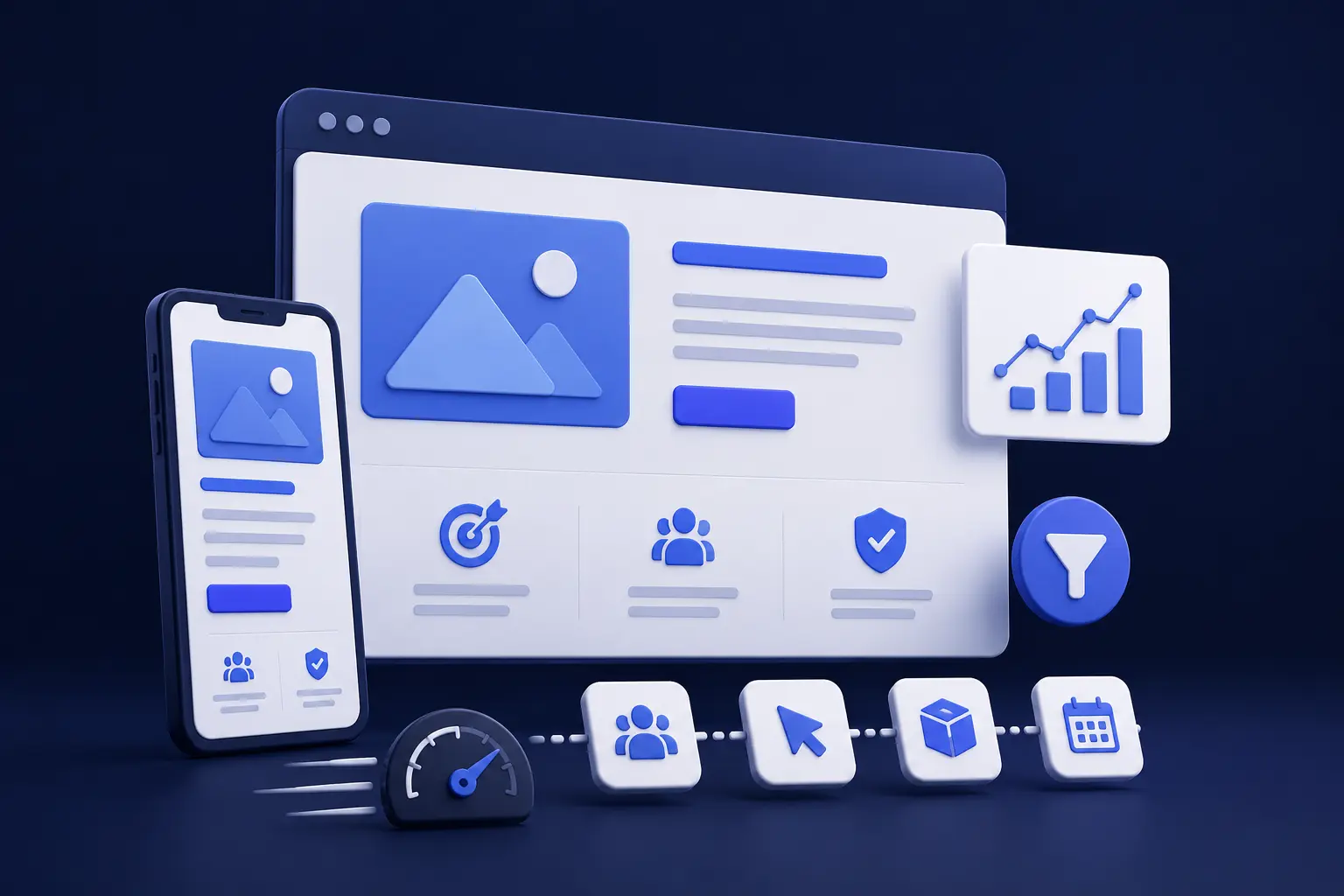
A landing page gives one campaign a focused destination for a specific marketing or advertising goal. Unlike broader website pages, it removes extra navigation so visitors focus on one offer and one desired action. Its importance comes from three functions: it focuses attention, boosts conversions and tracks results with clear campaign data.
Common types of landing pages include lead generation pages, click-through pages, product pages and event registration pages. A strong page needs a clear headline, benefit-focused copy, relevant visuals, social proof, a concise form and a prominent Call to Action (CTA).
Effective best practices keep one goal, use clear text, support mobile design and maintain fast page loading. A focused structure also helps teams compare campaign results, test page variations and identify which elements influence visitor action.
What is a landing page?
A landing page is a standalone web page built around a single marketing goal for visitors from ads, emails or social posts. Unlike a homepage, it limits navigation and competing links so visitors follow one focused path toward a desired action.
Its single focus can support a purchase, signup, guide download or demo request. No distractions keep attention on the offer, while a clear Call to Action (CTA) directs the next step and supports higher conversion rates.
Why is a landing page important?
A landing page is important because it focuses visitor attention on one offer and one specific action. It supports higher conversions and clearer campaign measurement. Its focused structure also creates a direct path from campaign message to visitor response.
The main reasons a landing page matters are listed below.
Higher conversions: Higher conversions can result when visitors see one relevant offer with one clear action and fewer competing choices.
No distractions: No distractions keep visitors focused on the offer instead of unrelated navigation links or alternative actions.
Message match: Message match connects the landing page promise with the original ad or email that brought each visitor there.
Better ad performance: Better ad performance can follow when landing page content closely matches the campaign message, offer and visitor intent.
Easy tracking: Easy tracking connects campaigns with specific offers, audiences and actions, giving marketers clearer performance data.
How is a landing page different from a homepage?
A landing page focuses on one specific offer and one conversion goal, while a homepage acts as a broad entry point that guides visitors across an entire website. Their purpose, navigation and traffic sources therefore serve different visitor needs.
The key differences between a landing page and a homepage are shown below.
What are the different types of landing pages?
Landing pages use different structures based on the campaign goal, visitor intent and action required from each page.
The 8 types of landing pages are listed below.
- Lead generation pages: Lead generation pages collect visitor details through forms in exchange for ebooks, checklists, consultations or other useful resources.
- Squeeze pages: Squeeze pages use minimal copy and one email opt-in form to capture visitor contact information with little distraction.
- Click-through pages: Click-through pages explain a product or service before visitors move toward checkout, pricing or signup through one clear action.
- Sales pages: Sales pages present product benefits, pricing, proof and objections to persuade visitors toward a direct purchase.
- Splash pages: Splash pages provide an introductory screen before the main website, often for announcements, language selection or age verification.
- Coming-soon pages: Coming-soon pages build interest before a launch and can capture email addresses from early visitors.
- Event registration pages: Event registration pages present details about webinars, conferences or workshops alongside a registration form.
- Thank-you pages: Thank-you pages confirm a completed action, provide the promised resource and guide visitors toward relevant next steps.
What are the key elements of a successful landing page?
A successful landing page needs clear messaging, one focused action, relevant proof and a friction-free path toward conversion.
The essential landing page elements are listed below.
Clear and compelling headline: A clear and compelling headline states the core benefit quickly and gives visitors a reason to continue.
Persuasive subheading: A persuasive subheading expands the headline and clarifies the offer, audience value and expected outcome.
Single Call-to-Action (CTA): A single Call-to-Action (CTA) directs visitors toward one action without competing choices or unnecessary page elements.
Engaging visuals or hero shot: Engaging visuals or a hero shot show the product, service or offer and reduce uncertainty before action.
Benefits over features: Benefits over features explain how the offer addresses visitor needs instead of presenting technical details without context.
Social proof and trust signals: Social proof and trust signals use testimonials, reviews, ratings or client logos to strengthen credibility.
Zero distractions: Zero distractions remove unnecessary navigation, sidebars and links that can pull visitors away from the conversion goal.
Mobile responsiveness and speed: Mobile responsiveness and speed ensure the page works smoothly across smartphones and supports a faster visitor experience.
How to create a high-converting landing page?
Create a high-converting landing page by defining one clear goal, matching the campaign message, reducing friction and guiding visitors toward one primary action.
The 9 steps for creating a high-converting landing page are listed below.
- Define one clear goal: Define one conversion goal, such as a signup, purchase, booking or demo request, before you build the page.
- Build the hero section: Build a focused hero section that states the value proposition quickly and places the primary call-to-action above the fold.
- Add social proof early: Add testimonials, client logos, ratings or relevant results near the top to establish credibility before visitors evaluate the offer.
- Present the problem and solution: Present the visitor’s problem clearly, then connect your product or service with a specific solution.
- Turn features into benefits: Turn product features into practical benefits that explain how the offer improves the visitor’s situation.
- Explain the process: Explain the service or offer through simple steps that reduce uncertainty and make the required effort easier to understand.
- Address objections: Address common questions, concerns and objections through an FAQ section before visitors reach the final decision.
- Strengthen the final CTA: Strengthen the final CTA with one clear action that reinforces the core benefit and gives visitors an obvious next step.
- Test and refine: Test headlines, CTAs, layouts and forms, then use conversion data to identify stronger page variations.
How to drive traffic to a landing page?
Drive traffic to a landing page through paid ads, organic search, email campaigns and direct social promotion. Match each channel with the page offer, audience intent and campaign message to attract relevant visitors and support conversions.
Paid advertising can capture high-intent searches through search ads and reach defined audiences through social platforms. Retargeting can reconnect with visitors who leave without completing the desired action.
Organic search can attract relevant visitors through Search Engine Optimization (SEO), useful content and internal links. Email campaigns can reach segmented subscribers, while social sharing can extend the page’s reach through company channels and relevant communities.
What are the best practices for landing pages?
The best landing page practices focus on a clear value proposition, minimal distractions and one dominant Call-to-Action (CTA). Each element should support the visitor’s decision without adding unnecessary friction.
The key landing page practices are listed below.
- Clear headline: State the core benefit quickly so visitors understand the offer without searching for its purpose.
- Supporting subheadline: Explain the offer in simple terms and connect its value with the visitor’s immediate need.
- Compelling visual: Use a relevant image, product view or short video that clarifies the offer and reduces uncertainty.
- Immediate CTA: Place one prominent CTA where visitors can see it quickly and understand the required action.
- Remove distractions: Remove unnecessary navigation, sidebars and links that can pull visitors away from the conversion goal.
- Use whitespace: Use sufficient space between sections, text and visuals to improve scanning and reduce visual clutter.
- Match your traffic: Match the headline and page message with the ad, email or link that brought visitors there.
- Add social proof: Add authentic testimonials, reviews, client logos or relevant statistics to strengthen trust before visitors decide.
- Reduce friction: Ask only for essential information in forms and keep the next step simple for visitors.
What common mistakes should you avoid when creating a landing page?
Avoid unclear headlines, weak CTAs, cluttered layouts, slow loading speeds and poor mobile experiences that can reduce landing page conversions.
The most common landing page mistakes are listed below.
- Unclear headlines: Unclear headlines hide the main benefit and make visitors question whether the offer matches their needs.
- Weak CTAs: Weak CTAs use vague labels or multiple actions that create uncertainty about the visitor’s next step.
- Too much clutter: Too much clutter adds unnecessary navigation, links, visuals or dense copy that competes with the primary conversion goal.
- Slow loading speed: Slow loading speed can frustrate visitors before they see the offer, especially on mobile devices or weaker connections.
- Poor mobile design: Poor mobile design creates difficult reading, awkward forms and buttons that remain difficult to tap on smaller screens.
- Excessive form fields: Excessive form fields demand unnecessary information and can increase hesitation before visitors complete the intended action.
- Mismatched messaging: Mismatched messaging creates a gap between the original ad and landing page, which can weaken relevance and trust.
- No testing: No testing leaves headline, CTA, layout and form decisions without evidence about which version produces stronger results.
How to measure the success of a landing page?
Measure landing page success through conversion data, visitor behavior and traffic quality. These metrics show whether the page attracts relevant visitors and moves them toward the intended action.
The key landing page metrics and analysis methods are listed below.
Conversion rate: Conversion rate shows the percentage of visitors who complete the primary action, such as a form submission, signup or purchase.
Bounce rate: Bounce rate shows how many visitors leave without meaningful interaction, which can reveal problems with relevance, messaging or page experience.
Average time on page: Average time on page indicates whether visitors spend enough time with the content to understand the offer.
Traffic sources: Traffic sources reveal which channels deliver visitors and which sources produce stronger engagement or conversion results.
Page load speed: Page load speed affects visitor experience because slow pages can increase drop-offs before visitors reach the primary action.
A/B testing: A/B testing compares headlines, CTAs, layouts or forms to identify page variations that produce stronger conversion results.
Heatmaps and session recordings: Heatmaps and session recordings reveal visitor behavior, interaction patterns and points where users hesitate or abandon the page.
What else should you know about landing pages?
A landing page works best when it supports a single goal and guides visitors toward one specific action. A clear headline should communicate the offer quickly, while one Call-to-Action (CTA) should provide an obvious next step without competing choices. Remove no distractions through unnecessary navigation, extra links and visual elements that can divert attention from the offer.
Fast load speed also matters because visitors may leave before they engage when a page takes too long. Prioritize mobile design so visitors can read content, navigate sections and complete the intended action across smaller screens. These elements create a focused experience that helps visitors understand the offer quickly and act with less friction.
What are some successful landing page examples?
Successful landing page examples use focused offers, persuasive copy and clear actions across SaaS, ecommerce and education campaigns. Strong website design supports concise benefits, relevant visuals, social proof and one conversion path.
Can you create a landing page without a website?
Yes, you can create a landing page without a complete website through standalone builders or a dedicated subdomain. However, consistent website design can strengthen brand trust, campaign continuity and visitor confidence.
How long should a landing page be?
A landing page should contain enough content to explain the offer, establish trust and address important visitor objections. Simple offers need fewer sections, while complex B2B solutions require more detailed information before conversion.
Do you need a domain for a landing page?
No, a landing page does not require your own domain because many platforms provide hosted subdomains. However, a branded domain or subdomain can strengthen credibility, improve brand consistency and support campaign recognition.
What is the best landing page builder?
The best landing page builder depends on your campaign goals, budget, integrations and preferred design control. Popular platforms include Unbounce, Instapage, Leadpages and Webflow, with different capabilities for templates, customization and integrations.
.svg)
.svg)
.svg)
.svg)