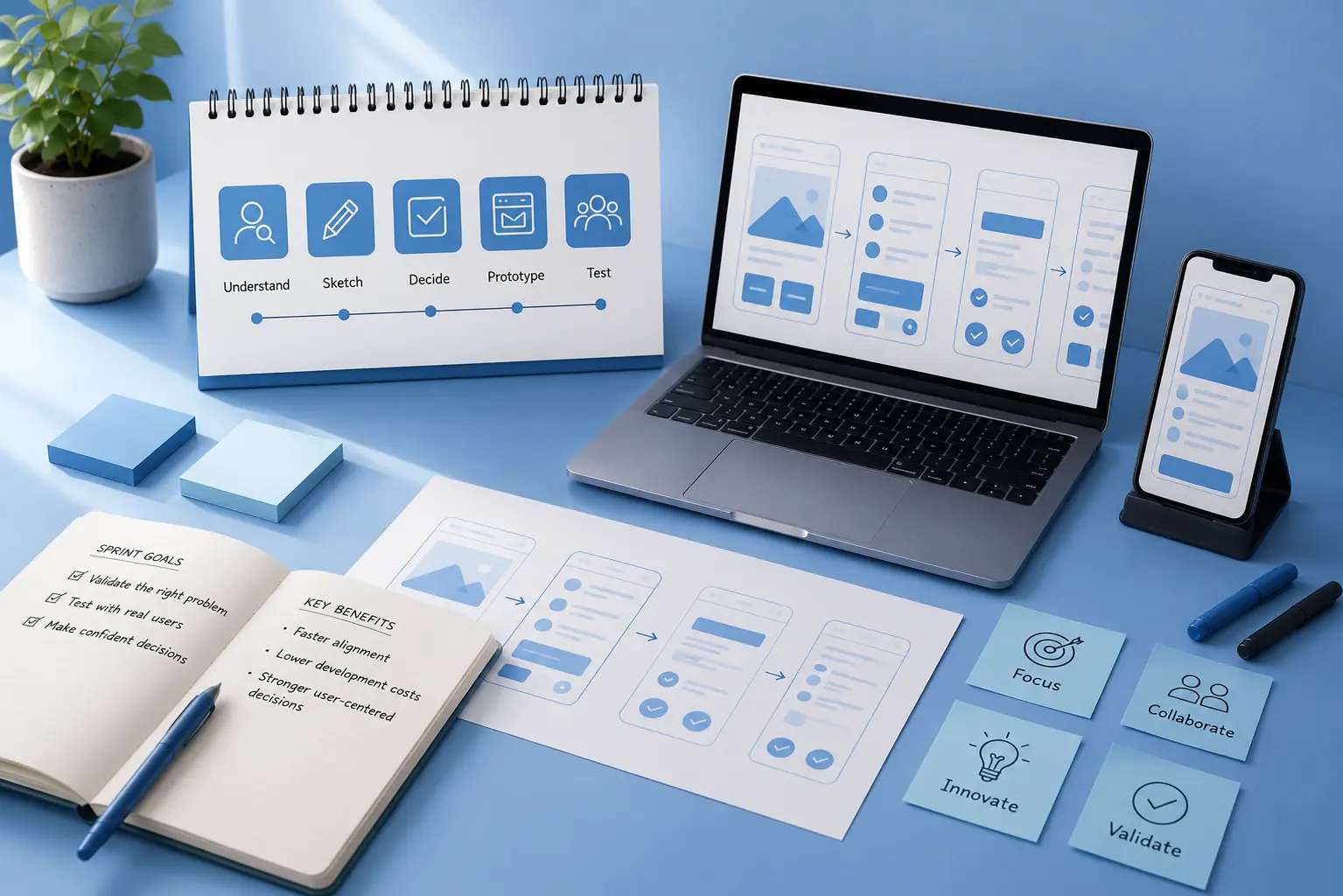
A design sprint is a fast, five-day framework created by Google Ventures to help teams solve hard problems through structured collaboration and rapid validation. It takes a team from a defined challenge to a tested solution within a single week. This approach reduces project risk, saves development resources, and helps organizations confirm product direction before major investment. Teams often use it to launch new products, redesign existing features, and evaluate business ideas before full development begins.
The design sprint process follows five structured phases: understand, sketch, decide, prototype, and test. Each phase moves the team from problem definition to decision-making with a clear objective. During the process, it produces realistic prototypes that represent the intended product experience without full implementation. The team then uses them to test ideas with real users, verify assumptions, and collect practical feedback. A facilitator, decision-maker, designers, engineers, and product stakeholders contribute expertise throughout every stage.
The outcomes of a design sprint include validated concepts, clearer priorities, and greater confidence in the next steps. Its benefits include faster team alignment, lower development costs, and stronger user-centered decisions. Its limitations include intensive preparation, full team availability, and a narrow scope for complex problems. Strong facilitation, clear problem framing, and early user participation help every sprint deliver more reliable results.
What is a design sprint?
A design sprint is a fast, five-day framework created by GV (Google Ventures) to help teams solve critical business problems through a structured decision-making process. It takes a team from a defined challenge to a validated solution before significant resources support full development. This approach replaces lengthy planning with a focused workflow that reduces uncertainty and improves decision quality.
The design sprint process evaluates possible solutions, selects the strongest direction, and produces realistic prototypes that closely resemble the intended product. The team uses these prototypes to test ideas with real users, gather direct feedback, and confirm whether the solution meets user needs. This evidence replaces assumptions with informed decisions and gives stakeholders greater confidence before full development begins.
Why is a design sprint important?
A design sprint is important because it saves time, reduces risk, and aligns teams around a shared solution before major resources support product development. It compresses traditional planning into a focused five-day process that helps teams validate decisions early with real user feedback. This approach replaces assumptions with evidence and gives stakeholders greater confidence before implementation begins.
The key benefits of a design sprint are listed below.
Speed: Speed shortens weeks of planning into a focused five-day process that helps teams make informed decisions faster.
Risk Reduction: Risk reduction validates ideas with real user feedback before major investment, reducing costly mistakes and unnecessary development.
Team Alignment: Team alignment gives designers, engineers, product owners, and stakeholders a shared direction that minimizes conflicting priorities and improves collaboration.
What problems does a design sprint solve?
A design sprint solves high-stakes business challenges because it turns uncertainty into validated decisions before full product development begins. Designers, product managers engineers and decision-makers follow a structured process that clarifies priorities and establishes one shared direction. Stakeholders validate ideas before major investment, which reduces financial risk and supports confident decisions.
The key problems a design sprint solves are listed below.
Analysis Paralysis: Analysis paralysis delays decisions. A design sprint sets clear deadlines and produces a tested prototype.
Misalignment: Misalignment creates conflicting priorities. A design sprint establishes one shared direction.
High Financial Risk: High financial risk comes from untested ideas. A design sprint validates concepts before full development.
When should you use a design sprint?
You should use a design sprint when designers, product managers, engineers and decision-makers face high-stakes, complex or ambiguous problems with no clear solution. It also helps organizations start a new project with shared priorities and clear direction from the beginning.
Stakeholders can also use it to remove project roadblocks and validate a new product feature before full development, so major investment supports ideas that real users have already confirmed.
The ideal scenarios for using a design sprint are listed below.
High Uncertainty: High uncertainty justifies a design sprint when complex problems have no clear solution.
New Initiatives: New initiatives benefit from shared direction before project work begins.
Stuck Projects: Stuck projects regain momentum through a structured and time-boxed process.
User Validation: User validation confirms a new product feature before full development.
How does a design sprint work?
A design sprint follows a structured five-day framework, originally developed at GV, that takes designers, product managers, engineers and decision-makers from an undefined challenge to a validated solution within one week. Each day has a specific objective that guides participants toward one clear solution.
A design sprint narrows multiple ideas into one testable concept through a series of structured decisions. The final stage produces a tested prototype and real user feedback, which give stakeholders reliable evidence before full development begins.
The five-day design sprint process is listed below.
Monday (Understand & Map): Monday defines the problem, maps the challenge and identifies a clear target.
Tuesday (Sketch): Tuesday develops multiple solution concepts through individual sketches.
Wednesday (Decide): Wednesday selects the strongest concept through structured critique and voting.
Thursday (Prototype): Thursday creates a realistic prototype for user testing.
Friday (Validate): Friday collects real user feedback and verifies the prototype.
Who participates in a design sprint?
A design sprint brings together 4 to 7 participants from different disciplines to solve a complex problem from multiple perspectives. Designers, product managers, engineers, business stakeholders and user-focused specialists contribute unique expertise that supports faster and more informed decisions.
A Design Sprint Facilitator leads the process, while the Decider makes final decisions whenever the group reaches a disagreement. This structure keeps the sprint focused and maintains steady progress throughout the five-day framework.
The participants in a design sprint are listed below.
The Decider: The decider resolves disagreements and selects the final direction.
The Facilitator: The facilitator leads sprint activities and keeps every stage on schedule.
Product Manager: The product manager aligns sprint goals with business priorities.
Designer: The designer defines the user experience and visual direction.
Engineer or Developer: The engineer or developer evaluates technical feasibility.
Marketer or Sales Representative: The marketer or sales representative provides market and customer insights.
Customer Support or User Researcher: The customer support specialist or user researcher contributes direct customer feedback and user insights.
What is the Understand phase of a design sprint?
The Understand phase is the first step of a design sprint and takes place on the first day to establish a shared understanding of the problem. Designers, product managers, engineers, stakeholders and other participants review the challenge through Expert Interviews, where specialists share context, constraints and prior research.
The Understand phase also examines user needs and defines long-term targets. Mapping the Problem organizes available information into a clear view of the challenge before the next stage begins.
The key goals of the Understand phase are listed below.
Build Alignment: Build alignment creates a shared understanding of the problem.
Learn User Needs: Learn user needs reveal customer pain points through expert interviews and research.
Define Long-Term Targets: Define long-term targets establish a clear direction for the sprint.
What is the Sketch phase of a design sprint?
The Sketch phase is the second stage of a design sprint and takes place on the second day, where participants turn abstract ideas into concrete visual solutions. Individual participants develop solution concepts on their own before the group reviews every approach. This method encourages independent thinking and preserves a wide range of ideas.
The key steps in the Sketch phase are listed below.
Lightning Demos: Lightning Demos present successful solutions from other companies to inspire new ideas.
Note-Taking: Note-taking captures useful insights from demos and discussions.
Crazy 8s: Crazy 8s challenges each participant to sketch eight solution variations in eight minutes.
What is the Decide phase of a design sprint?
The Decide phase is the third stage of a design sprint and takes place on the third day, where participants evaluate solution concepts and select the strongest option. Designers, product managers, engineers, stakeholders and the decider review every proposal through a structured decision process.
The Decide phase narrows multiple ideas into one clear direction and ends with a storyboard that guides the prototype.
The key activities in the Decide phase are listed below.
Art Museum: Art Museum displays every sketch for silent review.
Heat Map: Heat Map highlights the strongest ideas through dot voting.
Speed Critique: Speed Critique collects feedback on each sketch.
Straw Poll: Straw Poll records each participant's preferred solution.
Supervote: Supervote gives the decider final authority to choose the winning concept.
Storyboarding: Storyboarding creates a step-by-step plan for the prototype.
What is the Prototype phase of a design sprint?
The Prototype phase is the fourth stage of a design sprint and takes place on the fourth day, where participants create a realistic version of the chosen solution. Designers, engineers, product managers and other participants select tools, divide responsibilities and prepare the prototype for user testing.
The Prototype phase transforms the selected concept into a realistic experience that users can evaluate before full development begins.
The key activities in the Prototype phase are listed below.
Build a Fast Model: Build a Fast Model creates a realistic prototype without full engineering.
Keep It Real: Keep It Real makes the prototype feel authentic to users.
Assign Roles: Assign Roles divides responsibilities across participants.
Select Tools: Select Tools chooses the right software or materials for the prototype.
What is the Validate phase of a design sprint?
The Validate phase is the final stage of a design sprint and takes place on the fifth day, where participants test the prototype with real users. Designers, product managers, researchers and stakeholders collect evidence that confirms what works and identifies what requires improvement.
The Validate phase provides reliable user feedback before full development begins. The results help stakeholders decide whether to continue, refine or reject the proposed solution.
The key activities in the validate phase are listed below.
User Interviews: User Interviews collect direct feedback from real users.
Observation: Observation reveals user behavior and usability issues.
Team Review: Team Review evaluates findings and defines the next steps.
What are the outcomes of a design sprint?
The outcomes of a design sprint include a tested high-fidelity prototype, real user feedback and a clear direction for the next stage of product development. Designers, product managers, engineers and stakeholders use these outcomes to support product decisions with real evidence.
The outcomes of a design sprint reduce uncertainty before development begins. They provide practical assets and validated insights that support the next steps.
The key outcomes of a design sprint are listed below.
Clickable Prototype: A clickable prototype demonstrates the solution through a realistic interactive experience.
User Research Data: User Research Data captures direct feedback from real users.
Actionable Roadmap: Actionable Roadmap defines the next steps after validation.
Shared Alignment: Shared Alignment establishes one clear direction across stakeholders.
Time Savings: Time Savings reduces time spent on planning and repeated revisions.
What are the benefits of a design sprint?
The benefits of a design sprint include faster decisions, lower risk, stronger collaboration and better product validation within a five-day framework. Designers, product managers, engineers and stakeholders solve critical problems before full development begins.
The benefits of a design sprint improve product quality and reduce unnecessary work. Real user feedback and structured collaboration support confident business decisions.
The key benefits of a design sprint are listed below.
Speed: Speed shortens product planning and decision cycles.
Lower Risk: Lower Risk reduces costly mistakes through early validation.
Team Alignment: Team Alignment establishes one shared direction across participants.
User Focus: User Focus prioritizes decisions that reflect real user feedback.
What are the limitations of a design sprint?
The limitations of a design sprint include a full-week commitment, limited research depth and a small user testing sample. These constraints can reduce effectiveness when the problem requires extensive research or long-term validation.
The limitations of a design sprint also depend on the project and the participants. Unclear objectives, unsuitable project scope and strong hierarchy can reduce the quality of sprint outcomes.
The key limitations of a design sprint are listed below.
Full-Week Requirement: Full-Week Requirement requires every participant to commit five consecutive days.
High Burnout Risk: High Burnout Risk results from an intensive schedule.
Surface-Level Research: Surface-Level Research limits problem exploration.
Unsuitable Project Scope: Unsuitable Project Scope reduces effectiveness for overly simple or highly complex problems.
Vague Starting Points: Vague Starting Points weaken sprint outcomes.
Limited Testing Scope: Limited Testing Scope restricts validation to a small group of users.
Hierarchy Bias: Hierarchy Bias favors senior opinions during key decisions.
What are the best practices for a successful design sprint?
The best practices for a successful design sprint include user research, role preparation and a disciplined five-day schedule. Designers, product managers, engineers, stakeholders and facilitators achieve better results when every participant enters the sprint with clear objectives and reliable information.
The best practices for a successful design sprint also strengthen collaboration and improve decision quality. Consistent preparation, user validation and process discipline increase the value of every sprint.
The best practices for a successful design sprint are listed below.
Gather User Research: Gather User Research provides customer insights before the sprint begins.
Build a Diverse Group: Build a Diverse Group combines expertise from different disciplines.
Prepare Tools: Prepare Tools sets up software and resources before the sprint starts.
Stick to the Timeline: Stick to the Timeline keeps every stage on schedule.
Focus on the Core Problem: Focus on the Core Problem prevents unnecessary distractions.
Encourage Independent Work: Encourage Independent Work reduces groupthink during the Sketch phase.
Test with Real Users: Test with Real Users validates the prototype with target users.
Document Results: Document Results records key findings for future improvements.
What else should you know about a design sprint?
A design sprint also includes practical aspects beyond its five-day framework that you should understand before planning or participating in one. Teamwork, clear steps and fast tests guide participants through five days of structured activities, while feedback from real users helps solve big problems and save time before development begins.
You should also understand the sprint timeline, the tools that support each phase, the purpose of a design sprint brief, the options for remote collaboration and the criteria that determine sprint success. The following sections explain each topic in more detail.
How long does a design sprint take?
A design sprint takes five days and spans one full work week from start to finish. Participants complete the Understand, Sketch, Decide, Prototype and Validate phases in sequence. This structure suits website design projects and other complex product challenges that require rapid validation.
What tools are used in a design sprint?
A design sprint uses digital whiteboards, prototyping software and workshop materials throughout the process. Miro supports collaboration, Figma creates interactive prototypes and sticky notes organize ideas during in-person sessions. Website design projects often use the same tools to develop and validate prototype concepts.
What is a design sprint brief?
A design sprint brief is a short document that defines the sprint objective, target audience and expected outcomes. It establishes a shared direction before the sprint begins.
Can a design sprint be run remotely?
Yes, a design sprint can run remotely with digital collaboration tools and video conferencing platforms. Participants communicate, review ideas and complete every sprint activity through online collaboration.
How do you measure the success of a design sprint?
A design sprint succeeds when user testing confirms that the prototype solves the intended problem. User feedback, participant alignment and clear next steps indicate whether the sprint achieved its objective.
.svg)
.svg)
.svg)
.svg)